




Make seasonal bottles easy to return to
How to Store Fragrance Oils Between Seasons
Store fragrance oils upright, capped and labeled. Learn how to organize seasonal bottles, check old oils and avoid common storage mistakes.
The short answer
Store fragrance oils upright in their original labeled bottles, tightly capped and protected from heat and direct sunlight. Follow each label's storage instructions, keep the collection inaccessible to children and pets, and record opening dates. Product-specific supplier guidance determines shelf life; one universal expiry period does not fit every oil.
Keep the bottle useful
How should you store fragrance oils between seasons?
Store fragrance oils upright in their original, clearly labeled containers, with caps secure, in a cool shaded place away from heat and direct sunlight. Follow the bottle's storage instructions and keep oils inaccessible to children and pets. Record the opening date so next season's decision is based on the bottle's history.
A seasonal fragrance collection is easy to lose track of. The pine bottle moves behind the vanilla, a cap gets separated during refilling, and an unlabeled small container turns up months later. A useful storage system preserves identity as well as condition: what the oil is, what it is intended for, when it was opened and whether anything unusual happened to it.
This guide is for household fragrance oils, particularly waterless diffuser refills. It does not assign a universal expiry date to Aroma Paradise products. Use product-specific label or supplier guidance for shelf life and disposal.
A simple shelf system for a seasonal collection
- Keep the original bottle and cap. They retain the product name and use information. Do not move oil into a food, drink or unmarked travel container for convenience.
- Choose an appropriate cupboard. Keep it away from radiators, a sunny windowsill, a stove, a fireplace or an area with large temperature changes. A display shelf is not automatically a good long-term storage location.
- Store upright in a secondary tray. A stable tray helps organize bottles and contain a small leak. It does not replace a sound closure or the label instructions.
- Separate by intended use. Keep waterless diffuser oils distinct from candle, reed-diffuser, essential-oil or other products. Similar names do not establish interchangeable formulations.
- Record the opening date. Use a small removable label that does not obscure the original information. Keep any batch details readable.
- Check before returning to use. Inspect the bottle and compare its condition with what you recorded. If identity or condition is uncertain, ask the supplier before putting it into a diffuser.
The best container is usually the one supplied for that specific oil. Repackaging introduces decisions about material compatibility, closure and labeling that a household collection does not need. If a closure is damaged, get supplier guidance instead of assuming any spare cap fits correctly.
Storage locations: what to choose and what to avoid
| Location | Main issue | Better decision |
|---|---|---|
| Interior cupboard | Access and bottle stability still matter | Use a secure, shaded location appropriate for your household |
| Sunny windowsill | Direct light and changing temperature | Move the collection out of the sun |
| Beside a radiator or fireplace | Unnecessary heat exposure | Choose a separate storage area |
| Bathroom shelf | Changing conditions and confusion with personal-care products | Keep oils in a clearly separate labeled collection |
| Car or unconditioned garage | Large temperature swings and uncertain storage history | Follow the supplier's conditions in an appropriate indoor location |
| Unlabeled decanter | Lost identity, instructions and traceability | Retain the original labeled bottle |
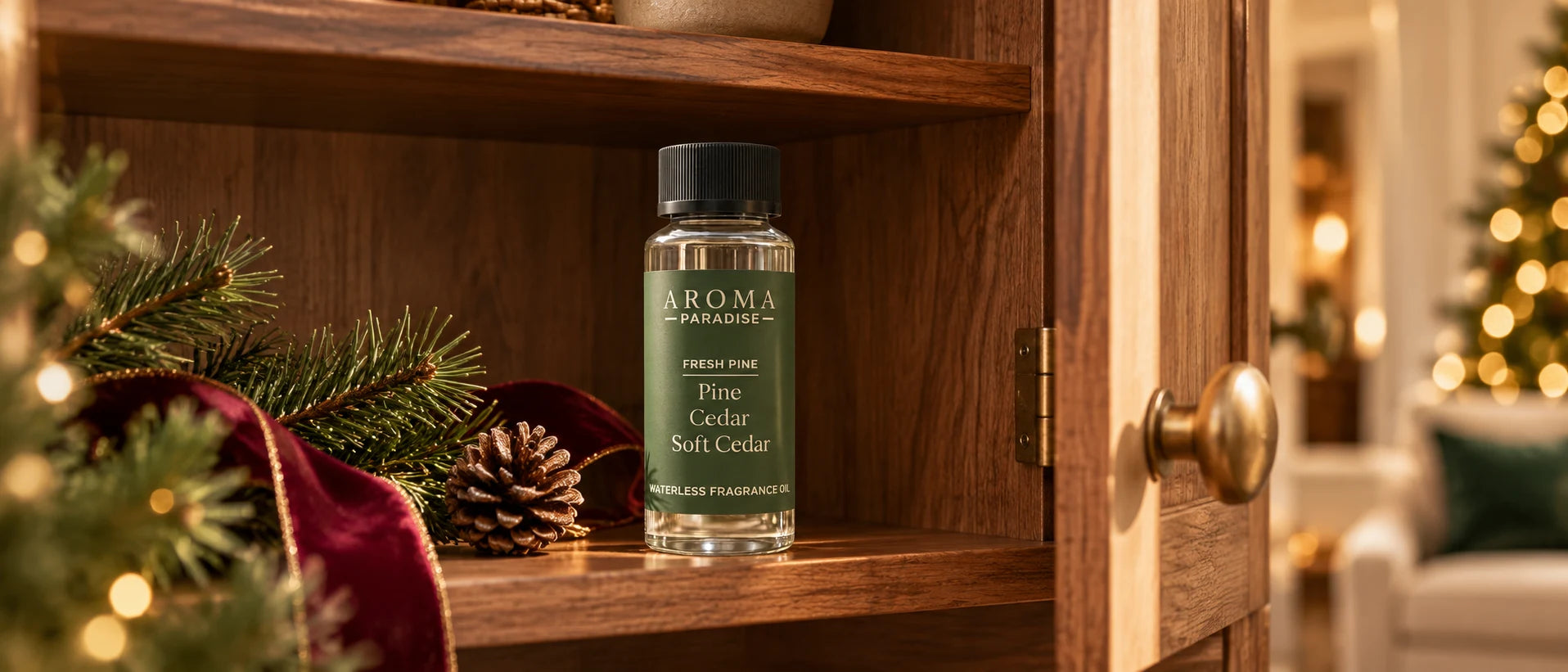
A decorative photograph may show a bottle on a console while it is being used. That is different from leaving it there throughout the year. After filling, cap the bottle, check the outside for residue, and return it to its designated place.
Does fragrance oil expire?
Fragrance oils can change during storage, but a single shelf-life number is not reliable across every formulation and brand. Check the specific supplier's guidance and the bottle's history. An unopened bottle stored appropriately and an opened bottle left in sunlight are not equivalent simply because they were bought on the same day.
CandleScience's guidance describes storage conditions and changes in oil as factors in deciding whether its products are still usable. That guidance concerns its own candle and soap fragrance range; it does not establish an Aroma Paradise expiry period or cold-air diffuser compatibility. The practical lesson for a household collection is to retain dates and storage information, then ask the supplier about the exact bottle.
Do not use smell alone as a safety test. A familiar aroma does not confirm that an unknown or contaminated liquid belongs in your device. If you cannot identify the product or know how it was stored, pause the experiment.
What should you check before using last year's oil?
Read the label first
Confirm the product name, intended use and any instructions. A seasonal name such as pine or cinnamon may appear on several formulations. Find the actual waterless product and check your device manual before making a refill. A candle fragrance or diffuser base from another system is not automatically a cold-air refill.
Inspect the container and liquid
Look for leakage, a damaged cap, unidentified material, or a substantial change from the original appearance. Record what you notice without deciding that every color difference means the same thing. Formulations differ, and a supplier can assess the exact product more accurately than a generic chart.
Check the storage history
Was the oil tightly closed, left beside heat, mixed with another oil or transferred to a different bottle? Did the device bottle get poured back into the original? Those details matter. Keep questionable oil separate while you ask for advice, and do not hide an uncertain liquid by topping it up with fresh oil.
If an oil is approved for reuse, test it according to the actual product and device directions. When the diffuser needs maintenance, use the waterless diffuser cleaning guide. Cleaning the device does not reverse deterioration or establish the suitability of a questionable oil.
A useful winter-to-spring handover
Before putting seasonal oils away, list what remains and when each bottle was opened. Keep the winter favorites together without combining their contents. Put the bottle you expect to use next where you can find it, while keeping the whole collection properly secured.
For the diffuser, follow the model's emptying and cleaning instructions rather than leaving a partially used reservoir forgotten for months. Do not return leftover device oil to the original bottle unless the manufacturer specifically permits it. Keep your next fragrance in its own original container until you are ready to fill the clean, compatible device.
Buying a larger bottle is useful only when your usage supports it. If you rotate between several oils, a smaller bottle may make the collection easier to manage. Bottle capacity alone does not tell you how many calendar days it will last: device output and operating hours affect consumption. Check current product sizes in the carousel below.
Method and sources
This is a household organization guide, not a shelf-life certification. Storage principles are informed by CandleScience's fragrance oil storage guidance; its product-specific shelf-life claims are not transferred to Aroma Paradise. Use the original Aroma Paradise label and device manual for your own setup, and contact Aroma Paradise with the product name and any batch details if condition or identity is uncertain.
Current waterless fragrance oils
Find the finished scent that fits your routine.
Compare current scent notes, available sizes and prices. Use only with a compatible device and follow the original product instructions.

Paraíso de los aromas original
Pino Fresco
El pino fresco se abre en cedro texturizado y se asienta sobre suave cedro para una atmósfera tranquila, aromática y reparadora.

Inspirado en el Hotel 1
A mi manera
El eucalipto fresco se abre en un suave jazmín y se asienta sobre un ligero ámbar para una atmósfera tranquila, aromática y reparadora.

Aroma Paradise original
Napa
La jugosa uva cabernet se abre en grosella negra y se asienta sobre un roble suave para un ambiente brillante, divertido y acogedor.

Ambiente de temporada
Felices Deseos
Dulces especias se abren a suaves acentos florales y se asientan sobre maderas cálidas y almizcle para una atmósfera arraigada, refinada y discretamente lujosa.
Swipe to explore 4 products
Frequently asked
Questions before your next refill.
Where should I store fragrance oils?
Use an appropriate cool, shaded location away from direct sun and heat, following the original label. Keep bottles upright, capped and inaccessible to children and pets.
Do fragrance oils expire?
Fragrance oils can change over time. Use guidance for the exact product and its storage history rather than applying a universal shelf-life number across brands and formulations.
Can I store fragrance oil in a clear bottle?
Keep the original container supplied for the product and protect it from direct sunlight. Do not assume repackaging into a decorative bottle preserves material compatibility or labeling.
Should I refrigerate fragrance oils?
Follow the supplier's stated storage conditions. Do not assume refrigeration is required or suitable for every formula, and keep fragrance oils separate from food and drink.
Can I combine leftover bottles for storage?
Keep them separate unless the supplier explicitly permits the combination and intended use. Combining leftovers can lose product identity and does not establish compatibility.
Can I use last year's Christmas fragrance oil?
Check its label, opening date, storage history and condition, then ask the supplier if uncertain. An old familiar smell alone does not verify suitability for your diffuser.
Keep the routine connected