


A room-by-room scent plan
One diffuser or several?
Use one device when the area shares airflow and one scent goal. Use multiple smaller zones when doors, levels, room functions or intensity preferences differ.
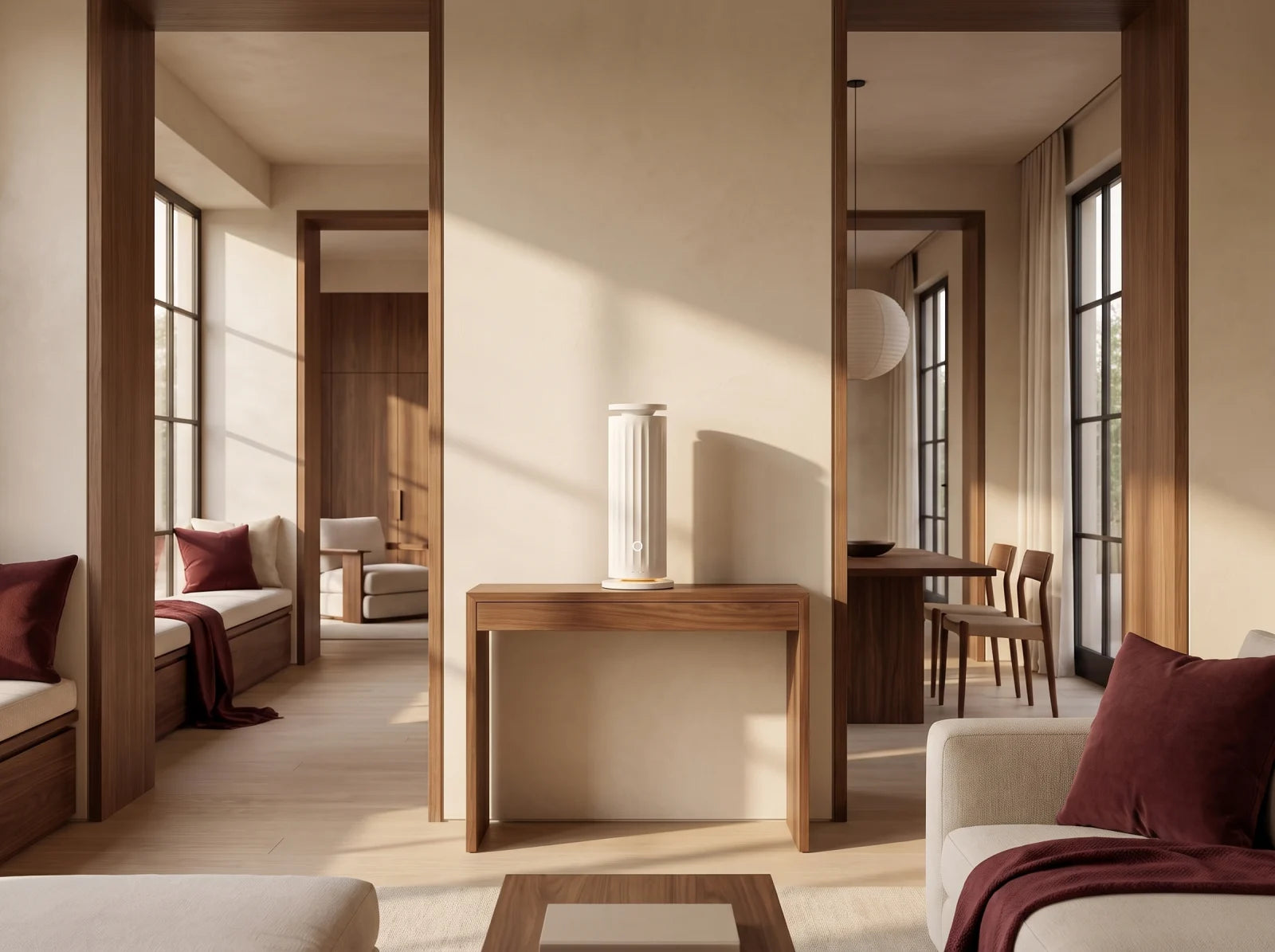
The short answer
Start with one diffuser for one connected scent zone. Add another only when a closed door, separate floor, competing room use or uneven airflow prevents the first device from creating a balanced result. More devices should create better control—not simply more fragrance.
Decision framework
Follow the air, then follow the routine.
Square footage is useful, but walls, doors, ceilings and HVAC returns change how scent moves.
- 01
Draw the zones
Group rooms that stay open and share airflow.
- 02
Name the job
Entry impact, everyday living, sleep or focused work.
- 03
Choose placement
Keep the outlet unobstructed and away from faces and surfaces.
- 04
Start low
Let fragrance circulate before changing intensity.
- 05
Add only if needed
Create a second controlled zone instead of overpowering the first.
One or many?
Use the smallest controllable system.
| Home layout | Starting plan | Why |
|---|---|---|
| Studio or one open room | One small-room device at a low setting | One shared air volume and one routine |
| Open living, dining and kitchen | One appropriately placed central device | Test circulation before adding hardware |
| Bedroom behind a closed door | A separate, lighter bedroom zone | Different airflow and intensity preference |
| Two floors | Plan each level as a separate zone | Stairs do not guarantee even distribution |
| Large open-plan area | Compare a large-space device with two smaller zones | Placement and control may matter more than maximum output |
| Whole-home HVAC route | Only a model designed for compatible HVAC placement | Installation and controls are model-specific |
Shop by intended fit
Match the device to the first zone.
Filter by verified intended room fit. Compare power, controls and refill details before deciding whether the home needs a second zone.

High-output waterless cold-air diffuser
PowerFlow Tower
Our highest-output standalone tower, with remote control, a 200 ml reservoir, and no app required.
- Tested 2× output rate
- Remote timing control
- 200 ml reservoir

Waterless cold-air diffuser
Arc Touch Plug-In
A compact no-app diffuser with four output levels, four timer presets and a rotating plug for upright wall-outlet placement.
- Four output levels
- No app required
- 30 ml internal bottle

Waterless cold-air diffuser
Contour Smart Plug-In
A compact direct-to-wall diffuser with a 60 ml oil reservoir, three intensity levels, repeating 3- or 6-hour routines and Bluetooth scheduling.
- App scheduling
- Three intensity levels
- 60 ml oil reservoir

Rechargeable waterless cold-air diffuser
Tower Ultra
An app-enabled rechargeable tower with cordless placement, IR remote, on-device control, six diffusion levels and a 120 ml oil reservoir.
- Cordless after charging
- Six diffusion levels
- App, remote or one-touch

Waterless cold-air diffuser
Portable Rechargeable Mini
A compact rechargeable waterless diffuser with USB-C charging and adjustable intermittent output.
- Cold-air atomization
- On-device buttons
- Rechargeable setup

Waterless cold-air diffuser
Luxury Aluminum Plug-In
A compact aluminum waterless diffuser that connects directly to a standard wall outlet.
- Cold-air atomization
- On-device buttons
- Corded setup

Waterless cold-air diffuser
Soft Illumination Tower
A freestanding waterless tower with remote control, on-device control, and ambient light.
- Cold-air atomization
- Remote + on-device button
- Corded setup

Waterless cold-air diffuser
Fabric Tower
A fabric-wrapped freestanding waterless tower with remote and on-device controls.
- Cold-air atomization
- Remote + on-device button
- Corded setup

Waterless cold-air diffuser
Tower Pro
An app-enabled waterless tower with IR remote, on-device control, and six diffusion modes.
- Cold-air atomization
- IR remote + on-device button
- Corded setup

Waterless cold-air diffuser
Candlelight Rechargeable
A rechargeable waterless diffuser with a cyclable 7-color light and USB-C charging.
- Cold-air atomization
- On-device buttons
- Rechargeable setup

Waterless cold-air diffuser
HVAC+
A whole-home waterless scent system for tabletop, wall-mounted, or HVAC-connected installation.
- Cold-air atomization
- On-device buttons
- Corded setup

Waterless cold-air diffuser
Smart Car
A rechargeable vehicle-vent diffuser with three intermittent modes and vehicle-sensing start and stop.
- Cold-air atomization
- On-device button
- Rechargeable setup

Waterless cold-air diffuser
Night Light Plug-In
A direct-to-outlet waterless diffuser with on-device controls, four timer choices, and a night light.
- Cold-air atomization
- On-device buttons
- Corded setup
Swipe to explore 13 products
Placement rules
Give fragrance room to circulate.
Do not aim at a surface
Keep the outlet clear of walls, curtains, furniture and artwork.
Avoid the face zone
Do not place concentrated output beside a pillow, chair or desk position.
Use normal airflow
A gentle room path is useful; a strong draft or open exterior door can move scent away too quickly.
Change one variable
Adjust placement, intensity or schedule separately so you know what improved the result.
“More zones can create more control. More output alone creates more guesswork.”
If fragrance seems strong near the device but weak elsewhere, use the weak-scent troubleshooting guide before buying another diffuser.
Four common layouts
Walls and doors create scent zones.
Square footage alone cannot show whether fragrance will move through the home.
| Layout | Starting plan | Placement test | When to add a zone |
|---|---|---|---|
| Studio or open loft | One adjustable device | Use a stable central edge, not a hidden corner | Only if sleeping and living areas need different routines |
| Open kitchen, dining and living area | One connected-zone test | Observe cooking airflow and HVAC movement | When odor control is complete but one end remains consistently unscented |
| Hallway with closed bedrooms | Separate shared and private zones | Test with doors in their normal position | When a closed room has its own schedule or fragrance preference |
| Two floors | One device per active floor as needed | Do not assume stairs distribute scent evenly | After testing the most-used floor at a moderate setting |
The 48-hour placement test
Move one variable at a time.
This sequence reveals whether the problem is position, schedule or a genuinely separate zone.
- 01
Choose the anchor room
Start where the household spends the most time and remove recurring odor sources first.
- 02
Use a moderate setting
Keep the fragrance, schedule and door positions consistent for ordinary use.
- 03
Leave and return
Re-enter after time away so olfactory adaptation does not decide the result.
- 04
Adjust placement once
Move the device away from a blocked corner or disruptive airflow before increasing intensity.
- 05
Add hardware last
Create another zone only when a closed room, separate floor or different routine remains underserved.
When to add another diffuser
Add a zone for a boundary, not for impatience.
A second device is justified by how the home is used, not by a few minutes of uneven scent after startup.
The area is connected
One moderate device may be enough when rooms remain open, share airflow and use the same scent schedule.
A door changes the routine
A closed bedroom, office or nursery creates a separate preference and operating schedule.
The scent is trapped
Strong fragrance beside the device with weak reach elsewhere usually calls for a placement test before more hardware.
Frequently asked
Whole-home scent-planning questions.
Can one waterless diffuser scent multiple rooms?
It can scent connected spaces when airflow carries fragrance between them, but a closed door or separate floor usually creates another zone. Confirm the exact model's intended fit and test one area before expanding.
Should every room use the same fragrance?
A coordinated scent family usually feels more intentional than several unrelated strong fragrances. Bedrooms and workspaces can use lighter settings or a quieter variation of the main direction.
Where should I put a diffuser in an open-plan room?
Start where the outlet is unobstructed and normal circulation can carry scent into the shared area. Avoid corners, direct drafts, return vents and placement aimed at a nearby surface.
How do I scent a 2,000-square-foot open space?
Compare layout, ceiling height, airflow, placement, control method and intended device fit. Do not choose from a bare square-foot claim alone; test a controllable zone and adjust from measured experience.
Method and sources
A planning framework, not a coverage guarantee.
The guide avoids universal square-foot promises. Product cards use current verified intended-fit tiers, while exact model evidence remains on the product page and in the maintained product-facts registry.
- U.S. EPA: Improving Indoor Air Quality — source control and ventilation come before fragrance.
- PubMed: Psychophysical and behavioral characteristics of olfactory adaptation — continuous exposure can reduce odor responsiveness.
- Aroma Paradise: Cold-air vs. ultrasonic diffusers — category definitions, method comparison and limitations.